

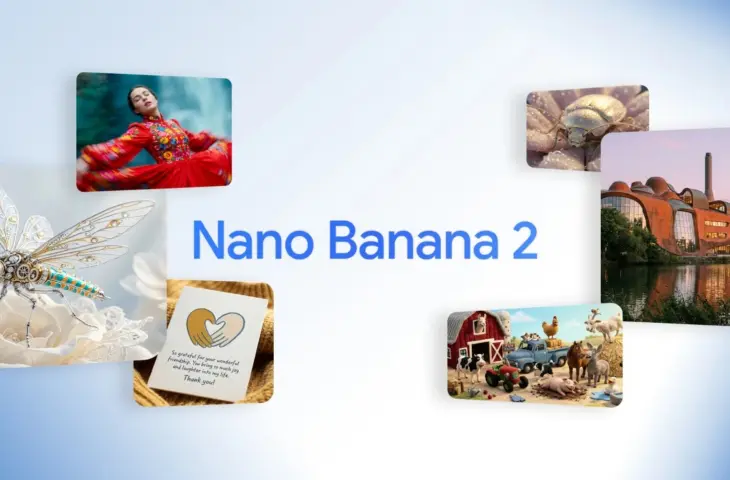
Google has just launched Nano Banana 2, its new flagship AI image generation model that combines Pro-level quality with Flash-level speed and makes advanced visual creation accessible to everyone, not just paying power users.
What Is Google Nano Banana 2?
Nano Banana 2 is Google’s latest generative image model, also known as Gemini 3.1 Flash Image, designed to merge the intelligence and fidelity of Nano Banana Pro with the responsiveness of the Flash family. It can generate and edit high-quality images from text prompts, sketches or notes, while grounding its visuals in real-world knowledge from the Gemini ecosystem and live web data.
The first Nano Banana went viral in 2025 for its creative capabilities, followed by Nano Banana Pro, a premium model focused on studio-grade quality but with slower generation times. Nano Banana 2 resolves this trade-off by offering Pro-like results at much higher speed, becoming the default image engine in the Gemini app and other Google experiences.
Key Features And New Capabilities
Nano Banana 2 is built to deliver both creativity and control for creators, marketers and developers.
Real-time world knowledge
The model taps into Gemini’s real-time knowledge base and images from web search so it can generate visuals that reflect current events, real places, brands, products or data, instead of relying only on static training. This makes it particularly useful for infographics, data visualizations and any image that needs to stay aligned with live information.
High-fidelity, production-ready images
Nano Banana 2 supports a wide range of aspect ratios and resolutions, from 512 px up to 4K, allowing you to create everything from social media posts to ultra-wide backdrops and campaign visuals with sharp detail. Google also highlights improvements in lighting, textures and edge sharpness, elevating the aesthetic quality of generated images.
Accurate text inside images
One of the main weaknesses of previous-generation models was messy or unreadable text embedded in visuals, but Nano Banana 2 significantly improves text rendering. You can now design marketing mockups, posters, product visuals or greeting cards with legible, properly spelled text, and even translate or localize this text directly inside the image for different markets.
Multi-character and multi-object consistency
The model can maintain the appearance of up to five characters and 14 distinct objects across a single workflow, enabling coherent storyboards, comic strips, educational sequences or branded campaigns that require visual continuity. For content creators, this means less manual retouching and fewer reshoots of generated scenes.
Advanced control over composition
Users get fine-grained control over aspect ratios (including ultra-wide formats such as 4:1 or 8:1) and can steer the style and complexity of the output with precise prompts. For developers, configurable “thinking levels” allow them to increase the model’s reasoning depth (Minimal, High, Dynamic) on complex prompts while keeping latency under control.
Where You Can Use Nano Banana 2
Google is rolling out Nano Banana 2 broadly across its ecosystem, from consumer tools to developer platforms.
Gemini app
Nano Banana 2 becomes the default image model in Gemini’s Fast, Thinking and Pro modes, bringing Pro-grade imaging to the free tier and mainstream users. Power users with AI Pro or Ultra subscriptions still have access to Nano Banana Pro for niche, high-fidelity workflows.
Google Search, Lens and Flow
The model powers image generation in AI Mode in Google Search, Google Lens and serves as the image engine in Flow, Google’s video and multimedia creation tool, with images not consuming extra credits in Flow. This integration lets brands and creators generate visuals directly where they already search, capture and assemble content.
Gemini API, AI Studio and Vertex AI
Developers can access Nano Banana 2 through the Gemini API, AI Studio, Vertex AI and other Google cloud tools to build apps that rely on fast, high-quality image generation. This opens the door to custom design assistants, automated marketing asset generators, creative tools for games, e-commerce visual engines and more.
Third-party tools and editors
An ecosystem of external tools is already emerging around Google’s image models, with editors and SaaS platforms integrating Nano Banana 2 for professional-grade, AI-powered editing workflows. For agencies and production teams, this means Nano Banana 2 can slot into existing pipelines rather than forcing a complete tooling reset.
Why Nano Banana 2 Matters For SEO And Content Marketing
For SEO and content marketers, Nano Banana 2 changes how visual content is conceived, produced and optimized on a daily basis.
Faster visual content at scale
Because the model combines speed and Pro-level quality, marketing teams can generate thumbnails, blog illustrations, social posts, ad creatives and A/B test variants in minutes, instead of days or weeks. This higher production velocity supports more frequent publishing schedules and richer content on key landing pages, which indirectly benefits organic performance.
Better engagement signals
High-quality, contextually relevant visuals help improve click-through rates and dwell time on pages, both on desktop and mobile. With Nano Banana 2’s improved text rendering and multi-language support, marketers can tailor on-image copy for each market while keeping brand visuals consistent, boosting engagement across international SEO campaigns.
Stronger topical authority
The model’s connection to real-time world knowledge and web images means you can visually represent current topics, trends and live data in an accurate way. For newsrooms, B2B content teams or niche blogs, this makes it easier to build comprehensive, visually rich resources that signal expertise and topical authority to both users and search engines.
Reduced production cost for rich content
Historically, high-end visuals like infographics, diagrams and multi-panel narratives required designers, illustrators and longer lead times, making them expensive to deploy at scale. Nano Banana 2 significantly lowers that barrier, allowing even small teams to enrich their content library with professional-looking visuals tailored to specific keywords, personas and funnel stages.
Practical Use Cases For Creators And Brands
From solo creators to large brands, Nano Banana 2 unlocks a wide spectrum of practical use cases.
Blog and resource center visuals
Transform long-form articles into visually engaging experiences by generating custom hero images, in-article illustrations, conceptual diagrams and summaries as infographics, all aligned with your target keywords and brand identity.
Product and e-commerce imagery
Create product lifestyle scenes, sizing diagrams, usage scenarios and promotional banners with consistent characters and objects, without always needing new photoshoots. The ability to localize text in images helps adapt the same visual concept to multiple languages and markets.
Social media and advertising
Design platform-optimized assets for Instagram, TikTok, YouTube, X and display campaigns by leveraging the model’s aspect ratio and resolution flexibility. Teams can quickly iterate creatives, test different visual angles and refine prompts to match performance data.
Storytelling and education
Use the multi-character consistency to build recurring mascots, educational characters or branded heroes that appear across series, onboarding flows, tutorials or newsletters. This narrative continuity reinforces brand recall and makes complex topics easier to digest.
Safety, Transparency And The Future Of AI Images At Google
Google is coupling Nano Banana 2 with reinforced safety and transparency mechanisms to address concerns around AI-generated visuals.
All images produced by Nano Banana 2 are automatically watermarked using SynthID and support C2PA Content Credentials, making it easier for platforms, media and users to detect and verify AI-generated content. This approach is designed to promote responsible use of generative images while still giving creators, marketers and developers powerful tools to innovate.
With Nano Banana 2 becoming the default engine across Gemini, Search, Flow and core cloud products, Google is clearly betting on this model as the new baseline for image generation on the web. For businesses and creators, now is the right time to experiment with Nano Banana 2, refine prompt strategies and integrate it into SEO, content and design workflows to stay competitive in the next wave of AI-powered visual content.

