

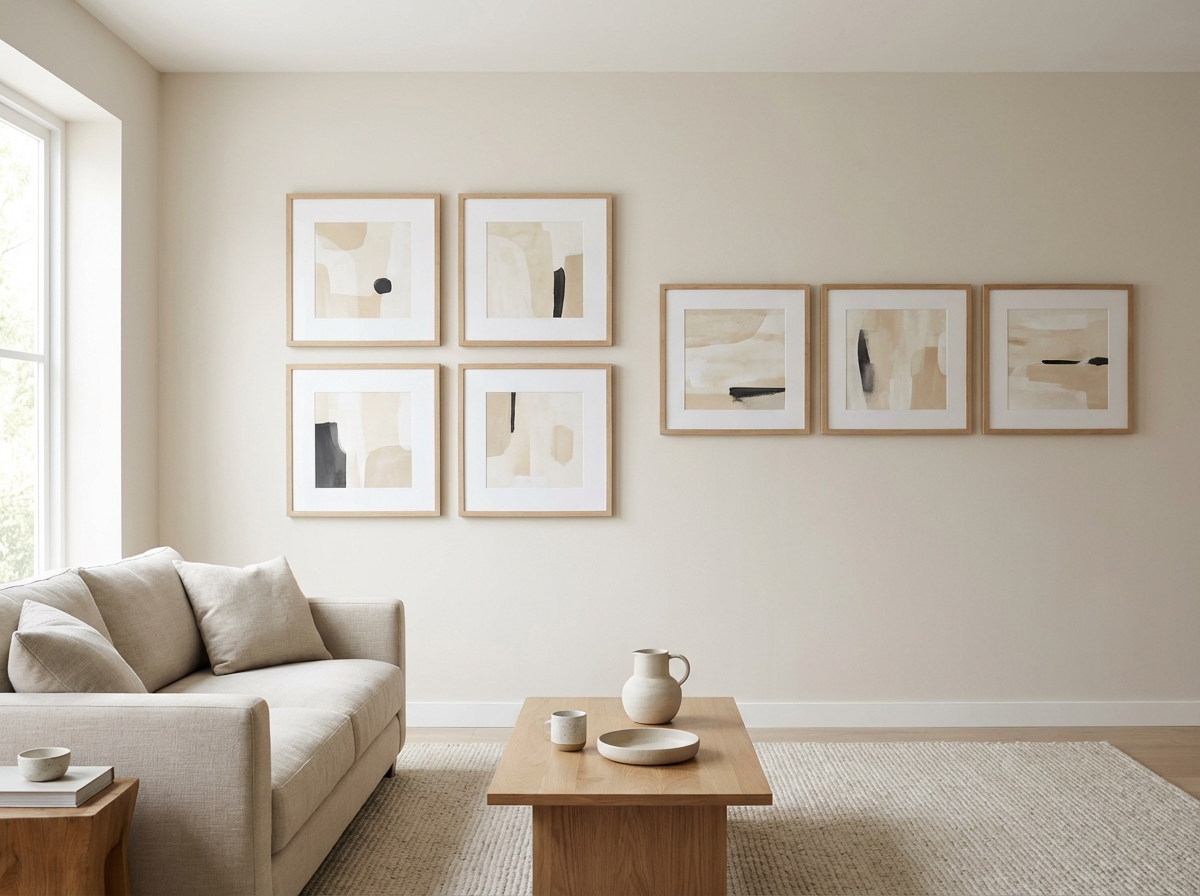
A gallery wall is one of the fastest ways to make a room feel finished. The challenge is making it look curated instead of random. AI makes it easier than ever to generate multiple artworks—but it also makes it easier to create a wall that feels inconsistent. This guide shows you how to design a modern gallery wall with AI art: the layouts that work, the sizing rules that keep it balanced, and prompt strategies for generating sets that match.
If you’re starting from scratch, begin with how to create stunning AI wall art. If you want prompt templates designed for matching sets, see AI wall art prompts that look expensive.
The One Rule That Makes Gallery Walls Look “Designer”
Pick a unifying system. That system can be:
- A shared palette (e.g. warm neutrals + one accent color).
- A shared style (e.g. minimalist abstract, fine art photography, botanical linework).
- A shared framing approach (all black frames, or all natural wood, or all thin metal).
Choose one system as your anchor. Two is okay. Three usually becomes chaotic.
Layout Ideas That Almost Always Work
1) The “One Large + Two Small” Classic
Place one anchor piece (largest) in the center or slightly above center, then add two smaller pieces to balance the sides. This is perfect above a sofa or sideboard.
2) The Symmetric Grid (Clean and Modern)
Use 4 or 6 prints of the same size. This looks calm and intentional—great for minimalist interiors. If your wall is wide, use a 3x2 grid. If it’s narrow, use a 2x2 grid.
3) The Vertical Stack (Perfect for Hallways)
Two or three pieces stacked vertically works in narrow spaces. Keep spacing consistent and frames matching.
4) The Triptych (One Artwork Split into Three)
This is one of the most “high-end” looks. Generate a single wide piece and split it into three coordinated panels. For prompt guidance, use the “set of three” template in AI wall art prompts.
Spacing, Alignment, and Hanging: The Details That Make It Look Intentional
Gallery walls look “designer” because the spacing is consistent and the group behaves like one big artwork. A few practical rules make a massive difference:
- Keep spacing consistent: pick a gap (often 5–8 cm) and use it everywhere.
- Align to a hidden grid: even organic layouts feel intentional when edges align.
- Center the group: treat the whole gallery wall as one piece and center that, not each frame individually.
- Eye level matters: the visual center of the group should land around eye height (often ~145 cm), adjusted for furniture below.
Tip: If you’re placing a gallery wall above a sofa or bed, you can “lower” the group slightly so it feels connected to the furniture. If you’re placing it in a hallway, keep the group more centered vertically and rely on consistent spacing.
How to Choose Your “Anchor Piece”
Most gallery walls fail because every piece is the same importance. Choose one anchor piece that sets the mood—either the largest print or the boldest composition. Then support it with quieter pieces. For example:
- Anchor: bold abstract with strong negative space.
- Support: two minimalist line pieces in the same palette.
If you’re generating with AI, you can design the anchor first, then generate the supporting pieces to match the palette and texture. This is where prompt consistency matters. Use prompt templates and keep the palette stable.
Three Ready-Made Gallery Wall Plans (Copy These)
Plan A: Calm Minimal Set (Best for Bedrooms)
- Style: minimalist abstract or misty landscape
- Palette: warm neutrals (beige, warm white, charcoal accent)
- Layout: 3-piece horizontal row (equal size) or triptych
Use prompts from minimalist AI wall art and keep contrast low so the wall feels calm.
Plan B: Modern Grid (Best for Living Rooms)
- Style: geometric color blocks or fine art photography
- Palette: cool neutrals + one accent (navy, olive, terracotta)
- Layout: 2x2 or 3x2 grid
A grid looks best when all prints share the same finish. If you’re choosing materials, use canvas vs paper guide and pick one for the whole set.
Plan C: Entryway Vertical Stack (Best for Hallways)
- Style: line art, botanicals, or minimal architecture
- Palette: monochrome or muted tones
- Layout: 2–3 pieces stacked
Vertical stacks look great in narrow spaces because they guide the eye. Keep frames matching, and avoid busy compositions.
How to Choose Sizes Without Guessing
Start with the wall and furniture, not the prints. A simple approach:
- Measure the width of the area you want to fill (above sofa, console, bed).
- Aim for 50–75% of that width across the whole gallery group.
- Keep spacing consistent (often 5–8 cm between frames).
For more detailed sizing guidance, read choosing the right size and frame and our room-based cheat sheet: best AI wall art sizes for every room.
How to Generate Matching AI Art Sets (Without Looking Copy-Paste)
Matching sets need consistency and variation. Use these rules:
- Same palette, different composition.
- Same medium, different subject (e.g. three landscapes with similar mood).
- Same negative space feel, different focal points.
Try this set prompt:
“Create a cohesive set of three artworks for a modern gallery wall: consistent palette of warm beige + soft grey + charcoal accent, minimalist abstract style, each artwork unique composition with generous negative space, designed to be displayed together.”
Material and Finish: Keep It Consistent
If one print is canvas and the others are matte paper, the wall can feel mismatched. Choose material once and stick to it across the set, especially for grids. For material guidance, read canvas vs poster vs fine art paper.
Make Sure Every Image Is Print-Ready
For a gallery wall, small flaws show up because you’re viewing multiple pieces close together. If you plan to print larger than medium sizes, read how to upscale AI images for large prints so your set looks sharp and clean.
Common Gallery Wall Mistakes (and How to Fix Them)
- Everything is the same: if every piece has equal visual weight, the wall can feel bland. Fix it by choosing one anchor piece and making the others quieter supports.
- Spacing is inconsistent: uneven gaps scream “DIY.” Fix it by picking one spacing number and sticking to it across the whole group.
- Palette clashes with the room: even great art can feel “wrong” if it introduces random colors. Fix it by constraining palette in prompts and using the color matching guide.
- Frames don’t match: mixing is okay, but you need a system (all black frames, or all wood, or all thin metal). If you’re unsure, follow size and frame.
- Group is too small: a tiny gallery wall floating above a sofa feels accidental. Fix it by sizing the entire group to 50–75% of furniture width (see sizes by room).
FAQ: Building a Gallery Wall With AI Art
Should I generate all pieces from one prompt? It’s better to generate a “family” of prompts: same palette + medium + mood, different composition. That creates coherence without looking duplicated.
Can I mix subjects (abstract + landscape)? Yes, if palette and frames unify the set. Keep one consistent element so the wall reads as one collection.
What’s the simplest approach for beginners? Use a 2x2 grid of the same size in the same frame color. Generate art in one palette using prompt templates, and you’ll get a clean, modern result fast.
Delivery Planning (Especially for Gifts)
Gallery walls are often created for a new home, a renovation, or a gift moment. For shipping timelines in Europe, read European delivery: what to expect. If you’re gifting a set, see personalized wall art gift guide.
Gallery Wall Pre-Order Checklist
- Wall plan: measure width/height and sketch the group as one rectangle.
- Layout choice: grid, stack, “one large + two small,” or triptych (choose one).
- Unifying system: decide what’s consistent (palette, style, or frames).
- Image consistency: make sure all pieces share similar contrast and texture.
- Material choice: pick one finish for the whole set (see material guide).
- Sharpness check: upscale if printing large (see upscaling guide).
This checklist sounds simple, but it prevents the two most common regrets: ordering a set that feels too small and ordering pieces that don’t look like they belong together.
Summary: A Gallery Wall You Won’t Want to Redo
Choose one unifying system (palette, style, or frames), pick a layout that suits the wall shape, select sizes based on the wall—not guesses—and generate a matching set with consistent mood and finish. With AI, you can design a gallery wall that looks curated, personal, and surprisingly premium.
Once you build one cohesive set, you’ll start seeing your walls differently: instead of “find random art,” it becomes “design a collection.” That shift is exactly what makes a home feel intentional. And it’s surprisingly fun to do.
Next: If your home style is calm and modern, read minimalist AI wall art: styles, palettes, and prompts.

